











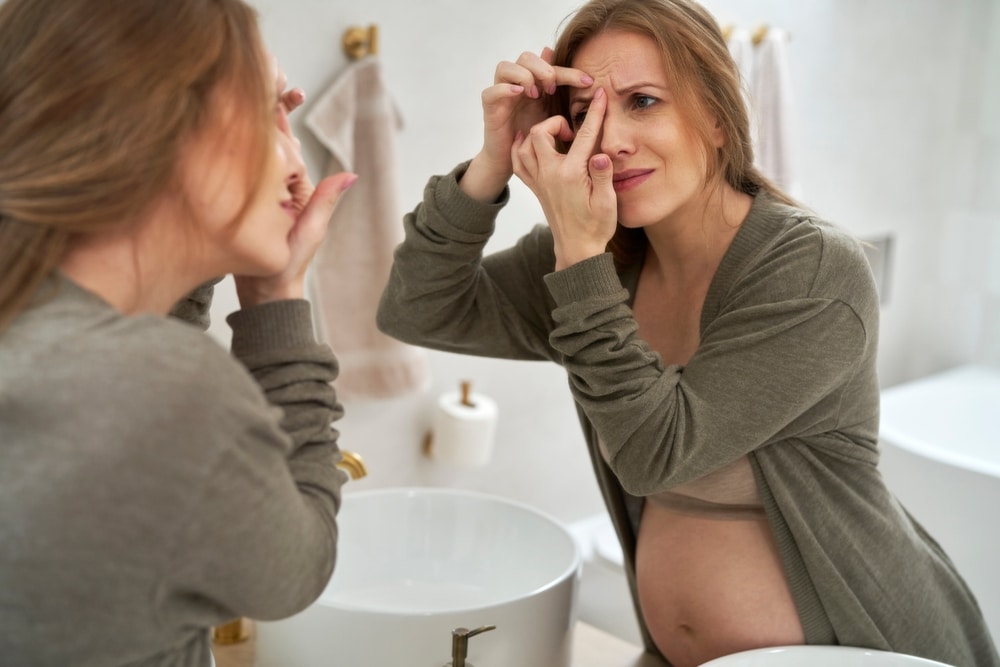
You’re growing an entire human, and your skin has decided now is the best time to launch a full-scale revolt. If pregnancy acne has you scrutinizing every mirror, you’re definitely not alone. Up to 43% of pregnant people experience acne during pregnancy, and for many, it’s not just a few stray pimples—we’re talking painful, under-the-skin breakouts that feel like a cruel cosmic joke.
The good news? According to Aegean H. Chan, MD, FAAD, a dual board-certified dermatologist and dermatopathologist, you don’t have to just endure until your hormones decide to take a break postpartum. There are safe, effective options available. It’s just a matter of knowing what works.
Why Pregnancy Acne Hits Different
Here’s what’s happening behind the scenes: Your body is swimming in progesterone right now. While this hormone is essential for supporting your pregnancy, it also plays a role in sabotaging your skin.
“Pregnancy acne is primarily driven by an increase in androgens like progesterone,” Dr. Chan explains. “These hormones stimulate the sebaceous glands, which leads to increased oil production and a greater likelihood of clogged pores and inflammation.” That excess oil combines with dead skin cells and bacteria, and boom—you’ve got breakouts.
Research confirms that progesterone levels surge dramatically during pregnancy, especially in the first trimester, stimulating increased sebum production that can lead to acne flares. If you’ve dealt with hormonal acne before, particularly along your jawline or lower face, your sebaceous glands are likely already reacting to these hormonal shifts.
When Does Pregnancy Acne Start and When Can It Get Better?
“The first trimester is when the endocrine changes of pregnancy accelerate,” says Dr. Chan. “Progesterone and human chorionic gonadotropin (hCG) increase rapidly, and estrogen fluctuates before stabilizing later in pregnancy.” Translation: Your hormones are on a rollercoaster right when you’re grappling with morning sickness and exhaustion. Fantastic timing, body.
The breakouts are often most active during the first and second trimesters, though some people notice improvement by the third trimester as hormone levels start to plateau. But—and this is important—it varies from person to person. Some experience calmer skin as pregnancy progresses, while others face breakouts throughout.
Studies indicate that pregnancy acne is most common in women with a history of acne. In fact, one study found 90% of pregnant women experiencing breakouts had dealt with acne prior to pregnancy. For some, lucky enough, acne improves during pregnancy due to shifts in immune balance and estrogen levels.
What Pregnancy Acne Actually Looks Like
If you’re noticing deep, painful bumps rather than standard surface-level zits, that’s classic pregnancy acne. “Since acne during pregnancy is fueled by androgen hormones such as progesterone, it’s more common to experience bumps under the skin, clogging and congestion of the lower face, and deeper nodules or tender cysts,” Dr. Chan notes.
The reach of pregnancy acne often goes beyond your face. Many pregnant individuals find breakouts occurring in areas they’ve never experienced acne before—like your chest, back, shoulders, and even your growing bump. The lower face, particularly around the chin and jawline, tends to be a hotspot, as that’s where hormonal acne typically presents. However, pregnancy acne can appear almost anywhere there are oil glands.
What Actually Works and What’s Safe
It’s frustrating when many standard acne treatments are off-limits during pregnancy. But Dr. Chan emphasizes: “One of the biggest myths is that you just have to ‘wait it out’ and that there’s nothing you can safely do for acne during pregnancy. That’s simply not true.”
Her top recommendations for pregnancy-safe acne solutions include:
Azelaic Acid
“Azelaic acid is my go-to for pregnancy acne,” says Dr. Chan. “It fights inflammation and bacteria, and it’s one of the safest options we have.” It also assists with post-inflammatory hyperpigmentation (those stubborn dark spots that linger after breakouts heal) and is gentle enough for sensitive skin during pregnancy. You can find it over the counter or request a stronger prescription from your dermatologist.
Gentle Acids
Lactic acid, mandelic acid, and PHAs work effectively because they unclog pores and smooth texture without irritating your skin. “I personally used The Ordinary’s 10% Lactic Acid + HA throughout all of my pregnancies, about 2-3 times a week,” Dr. Chan shares. Low-concentration glycolic acid (under 10%) is also considered safe. Just keep in mind that many people experience increased skin sensitivity during pregnancy, so moderation is key.
Benzoyl Peroxide and Salicylic Acid Cleansers
When used in cleanser form (which you wash off), these are generally low-risk during pregnancy and make good additions to your routine.
Sulfur
This traditional ingredient has natural antibacterial and anti-inflammatory properties. “It helps absorb excess oil without being harsh or irritating,” says Dr. Chan. You can apply it as a spot treatment or use it in a daily cleanser. Yes, it can have an unpleasant odor, but many newer formulas have minimized the notorious rotten egg scent.
For Severe Cases
Certain oral antibiotics like erythromycin are safe during pregnancy for more widespread or deeply inflamed acne. Dr. Chan also notes that painful cystic lesions can be treated in-office with low-dose corticosteroid injections—a quick, localized treatment that reduces inflammation without significant systemic absorption.
What to Absolutely Avoid
Let’s clarify what’s off-limits:
Retinoids
All topical and oral retinoids are contraindicated during pregnancy due to their potential to cause birth defects. This includes tretinoin, adapalene, isotretinoin (Accutane), and tazarotene.
Certain Antibiotics
Tetracyclines (including doxycycline and minocycline) are avoided because they can affect fetal bone and tooth development.
Anti-Androgen Medications
Spironolactone and similar hormone blockers can disrupt normal fetal development.
High-Strength Chemical Peels
Peels with more than 20% salicylic acid or trichloroacetic acid should wait until postpartum.
Bakuchiol
This trendy “natural retinol alternative” doesn’t function the same way retinoids do, and lacks robust safety data for pregnancy use. “It’s structurally different from vitamin A, so it’s likely low-risk, but that’s based on assumption rather than evidence,” Dr. Chan explains. She doesn’t personally recommend it for acne during pregnancy since there isn’t enough evidence showing it’s more effective than proven safe options.
A Simple Pregnancy-Safe Routine
Dr. Chan’s recommended routine is refreshingly straightforward:
Morning: Use a hydrating benzoyl peroxide or salicylic acid cleanser, followed by azelaic acid, then moisturizer and broad-spectrum sunscreen.
Evening: Gentle cleanser (medicated or hydrating, depending on sensitivity), a leave-on AHA or PHA exfoliant, then moisturizer.
“It really doesn’t need to be complicated,” emphasizes Dr. Chan. “Many people feel like they have to ‘dry out’ or be aggressive with acne, but in reality, consistent use of the right active ingredients is more effective and won’t disrupt your skin barrier in the process.”
The Emotional Piece Matters Too
Struggling with your skin while dealing with pregnancy’s many changes can be genuinely tough. “Your body and hormones are shifting rapidly, and when your skin doesn’t feel like your own, it can take a real emotional toll,” acknowledges Dr. Chan.
Her advice? Don’t feel like you have to manage things alone. “So many women try to troubleshoot independently, experimenting with product after product, spending months and a lot of money, when they could have found relief by consulting a dermatologist early on.” Having a dermatologist who understands pregnancy-safe options can make a huge difference—for both your skin and your peace of mind.
The Bottom Line
Pregnancy acne is common, frustrating, and can make you wish to hide away until your hormones stabilize. But you don’t have to see it as an unavoidable part of pregnancy.
“Just because your body is changing doesn’t mean breakouts are inevitable,” says Dr. Chan. “With the right guidance, we can manage pregnancy acne safely and effectively.”
And that reassurance is precisely what you need while navigating everything else pregnancy throws your way.